Utah is cracking down on people who possess child sexual abuse materials.
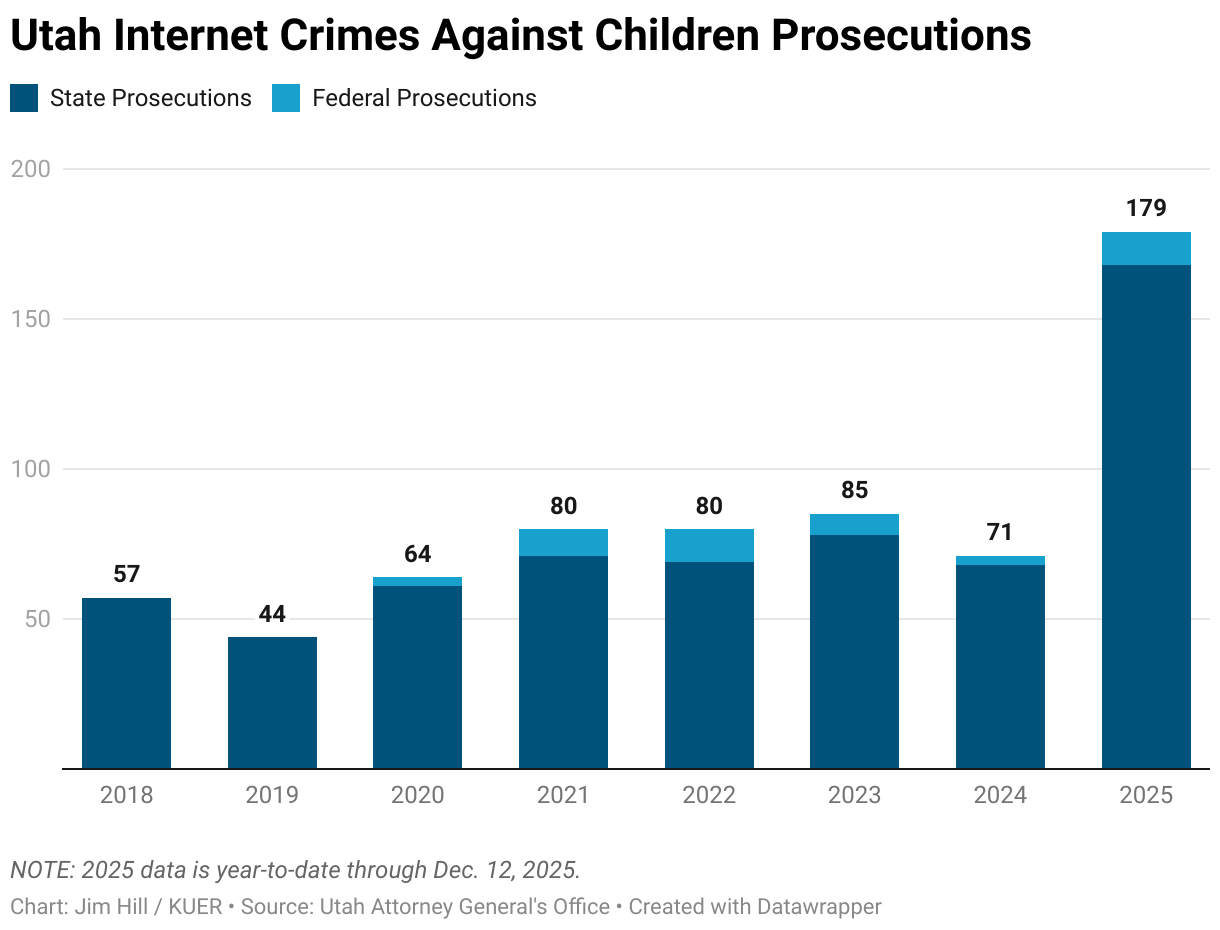
In 2025, the Utah Attorney General’s Office prosecuted more than double the number of cases involving internet crimes against children than in previous years. Data show 179 so far this year, compared to just 71 prosecutions last year.
These cases cover a broad number of offenses, from soliciting minors in online chat rooms to producing, acquiring and viewing child sex abuse material.
Stewart Young leads the criminal department in the Attorney General’s Office. He attributes the rise in prosecutions to a couple of factors, including better collaboration with local law enforcement and a more robust prosecution team.
Right now, the Internet Crimes Against Children Task Force has approximately 130 agents spread across Utah.
“The commander of our ICAC agent group has done a phenomenal job increasing the number of affiliates,” he said.
One of the key roles of agents outside of investigating online child abuse is training with affiliates throughout the state. Young said these crimes are complex, and giving local law enforcement the tools to investigate effectively has been a big help.
“It takes a while for the agent to understand, 'OK, here's how I document the CSAM going between these two parties,’ or ‘Here's how I document the text messages between the target and the minor,’” he said.

On the other side of Salt Lake City, long-time defense attorney Mark Moffat adjusted his glasses as he read printed notes about previous cases he’s worked on involving online child sex abuse material. He started his career as a public defender in Salt Lake City.
“For 10 years I worked there [as a public defender] and saw every kind of case that there was,” he said. “We never saw child pornography cases.”
But times have changed. Moffat said there’s been a steady rise in child sex abuse material-related cases coming across his desk — so many that he’s actually had to turn clients away.
The criminal world is nothing new to Moffat, and so it’s not the content that surprises him — it’s how his clients are getting it.
“A significant number of the people that I have represented have found themselves charged with CSAM because they’re searching for pornography and things like that on Google,” Moffat said.
Online child sex abuse material is often associated with what’s known as the dark web — a hidden part of the internet that requires software outside of typical web browsers to access it. It can act as a marketplace for stolen data, illegal weapons and CSAM.
But more and more, sites like Google, Facebook and Instagram are among the top platforms used to distribute illegal material.
Numbers from the National Center for Missing and Exploited Children show that in 2024 alone, there were 8.5 million reports for Facebook. As an organization, the center records the number of child sex abuse material and other instances of exploitation reported on U.S.-based websites. Its research shows a long-term trend of rising child sex abuse material.
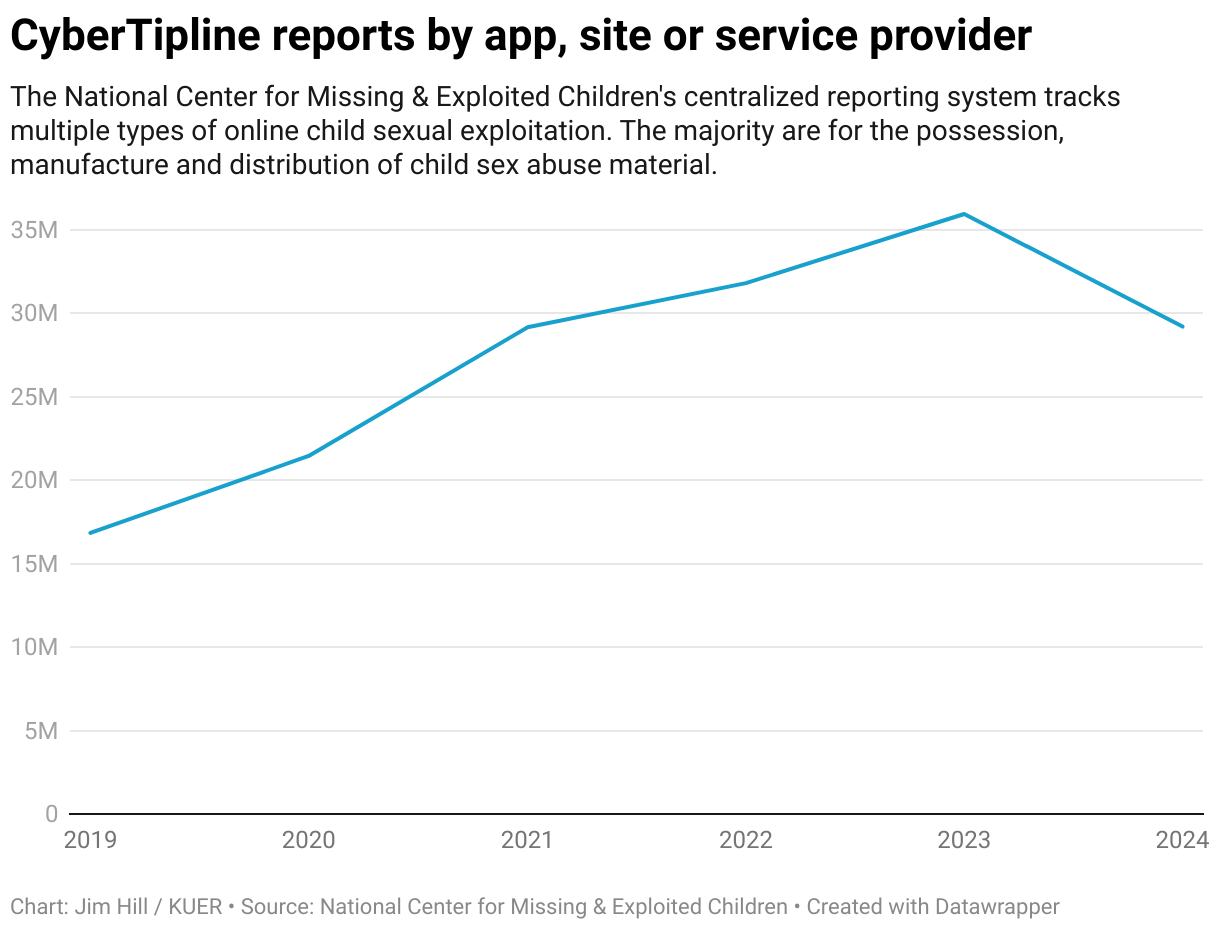
In Utah, Young said their tips from the center’s CyberTipline have been following the national trend. He told KUER that the state’s Internet Crimes Against Children task force has received over 9,500 tips so far this year, compared to approximately 6,800 in 2024.
Utah has been at the forefront of regulating online adult content. In 2023, Gov. Spencer Cox signed a bill mandating adult websites to age-verify users. In response, PornHub, the top worldwide adult site by traffic according to Similarweb, a web analytics company, cut off access to users in the state. The Free Speech Coalition, a trade and advocacy organization for the adult industry, initially challenged the law, but a judge dismissed the suit. From the onset, they had warnings beyond First Amendment concerns.
“We reached out to legislators and said, ‘Hey, listen, this isn’t going to do what you want it to do,’” said Mike Stabile, the coalition’s policy director. “It’s not going to protect minors. What it’s going to do is shift traffic away from legal, responsible, ethical sites to some of the worst sites on the internet.”
In Stabile’s view, the legislation took a misguided approach, and Utah is now seeing the results.
“What we’ve seen is a huge explosion in traffic to sites that are not only not age-verifying visitors, they’re not age-verifying the people who are in those movies,” he said.
A collaborative study from universities including Stanford and New York University gives weight to Stabile’s theory. It focuses on Louisiana, which passed an almost identical law the same year. Like Utah, PornHub blocked users there. Using Google Trends data, the study found that in the first three months, there was an almost 50% increase in searches for non-compliant websites.
Stabile explained that these non-compliant sites are often based overseas and don’t care about Utah law.
“These sites are largely located in places like Russia or India or the Netherlands — that is somewhat outside the reach of the state attorney general in Utah, or a parent in Utah who might file a lawsuit.”
From a ground level, Moffat said he’s seen a change in the clientele who seek his representation for accusations and charges for internet crimes against children.
“We have professionals, we have blue-collar workers, we have doctors, lawyers. I’ve represented psychiatrists who are being caught up in this by viewing these materials,” he told KUER.
“Whereas initially, when we started seeing these cases, they were people who were significantly under-socialized, and maybe the type of people that weren’t out or didn’t have good social skills.”

He’s concerned some of the people being prosecuted aren’t necessarily pedophiles or predators, but “porn addicts” who get caught in “the rabbit hole” after being redirected to less regulated sites. He said a significant number of his clients fit this description.
The Utah Attorney General’s Office says it deals with the big fish, and the majority of individuals they prosecute have been caught with “thousands of pictures, or they are trading thousands of pictures,” Young explained.
“We usually charge at least 10 charges — 10 counts of possession.”
To tackle the issue, Moffat and the Utah Defense Attorneys Association are looking for ways to “dam the river” and limit the amount of child sex abuse materials from making it to the end user by implementing filters.
“One of the things that we have discussed as an organization is basically tightening or creating some legislation to require that these tech giants that service all of us do more to eliminate child sex abuse material, child pornography, from their platforms,” Moffat said.
With AI technology under development, he doesn’t see why it couldn’t be used in this area.
According to the vice president of Veox AI, an artificial intelligence engineering and data company, Chris Brousseau, this technology already exists — but it's not AI.
“When we invented video and image processing is when we developed the ability to detect, ‘Is this video the same?’” he said, explaining that image recognition software pre-dates AI technology.
Brousseau said the FBI has the largest cache of known child sex abuse material from evidence the agency has collected over the years, and the material’s metadata – basically its DNA – could be used with an image filter to remove a large amount of this illegal content from the regular internet. He told KUER Utah’s tech industry is fully capable of working in this space.
“At least from a legislative standpoint, they already have the infrastructure for creating stuff like this as a state, and that could be a very viable direction,” he said.
But to truly accomplish this goal, it would need more government funding and grants.
Young with the Utah Attorney General’s Office said they’ll take all the help they can get to combat these crimes.
“We are doing the best we can with the tools that we have. If there are new, alternative, great tools out there that could help with this epidemic, we would be all for them as well.”