

For the second straight time, Salt Lake City set a new record for its warmest year. That’s according to National Oceanic and Atmospheric Administration data that goes back to 1875.
The city’s average temperature across 2025 was 57.7 degrees. That’s a full three degrees warmer than its historical average from the previous three decades. And it’s the culmination of several years of increasing warmth in Salt Lake City that has begun to top the record book.
“It looks like the past several years were in the top 15 or so,” National Weather Service Meteorologist Julie Cunningham said. “Kind of crazy to see that trend.”
Provo, Kanab, Bountiful and Boulder also set records for their warmest year in 2025. Several others, including Cedar City, St. George, Spanish Fork and Logan, saw temperatures that landed in their top 10.
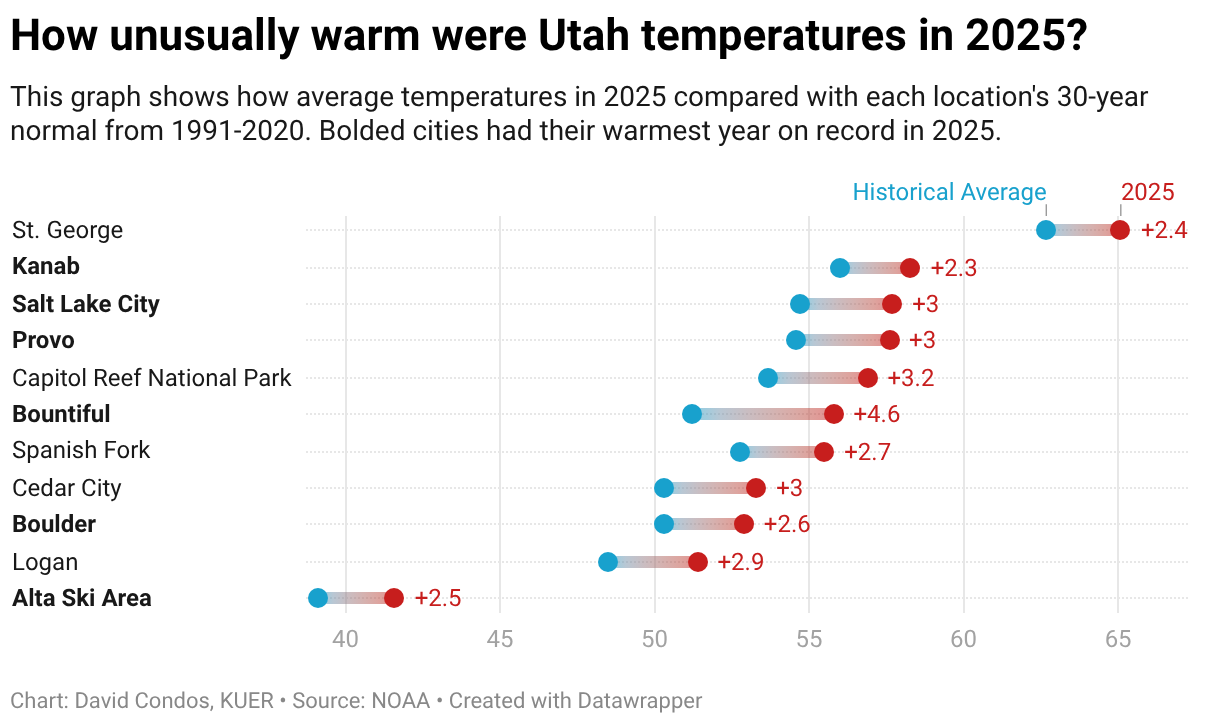
The summer of 2025 may not have had as many headline-grabbing heat waves as 2024 or 2023, Cunningham said, but it was consistently toastier than usual across the year as a whole.
The fall was Utah’s warmest on record. The week of Christmas, cities from Kanab to Tooele broke daily records. On Dec. 22, the overnight low temperature in Salt Lake City was so warm, Cunningham said, it even surpassed that date’s record for a daytime high.
“So, we beat our previous max temperature by two degrees,” Cunningham said. “That's just super unusual to see something quite like that.”
Scientists say the record-breaking temperature events are another example of how global climate change — driven by fossil fuel emissions — is affecting life in places like Utah.
That’s especially evident with the state’s precious water, said the University of Utah’s Paul Brooks.
“It's really a dual threat,” the professor of hydrology and water management said. “One is just reducing the amount of water we have, and two is changing its timing, so it's not as predictable as it once was.”
Higher temperatures fuel more evaporation. When temperatures increase across the year, it lengthens the season when evaporation occurs — essentially extending summer into parts of spring and fall.
Warming also messes with the foundation of Utah’s water supply: snow.
Snowpack provides 95% of the water used by Utahns. And Brooks said the state’s water management system is based on a predictable cycle of water becoming available when snow melts and flows downstream in the spring and early summer — just as demand for water starts to go up.

Warmer winters mean some precipitation that would have fallen as snow in years past arrives as rain instead. That’s part of what Utah has seen this season, Brooks said, as snowpack levels struggle across the state. And the unpredictability of it all creates challenging decisions for the water managers tasked with ensuring Utahns can turn on their taps.
“We're really moving into a very new environment,” Brooks said. “And that's what a lot of us are working on: What's it actually going to mean?”
Historically, Utah has been a leader in robust data and research about its climate and water resources, he said, but it takes a lot of behind-the-scenes work from an ecosystem of scientists to make that happen.
Now, even as the changing climate makes that work more vital than ever, the science community faces increasing roadblocks from the federal government.
“It's harder and harder to recruit the best students and scientists and researchers, and many researchers are moving to other countries. It can be a challenge to get things funded in this country. It can be a challenge to support the research that you want to do or that you feel needs to be done,” Brooks said. “And that's really hindering us moving forward in the future.”
Editor’s note: KUER is a licensee of the University of Utah but operates as an editorially independent news organization.


