

Southwest Utah leaders welcomed the Trump administration’s latest approval of the plan to build the Northern Corridor Highway. Conservationists vowed to fight back and stop the 4.5-mile road from ever crossing the Red Cliffs National Conservation Area.
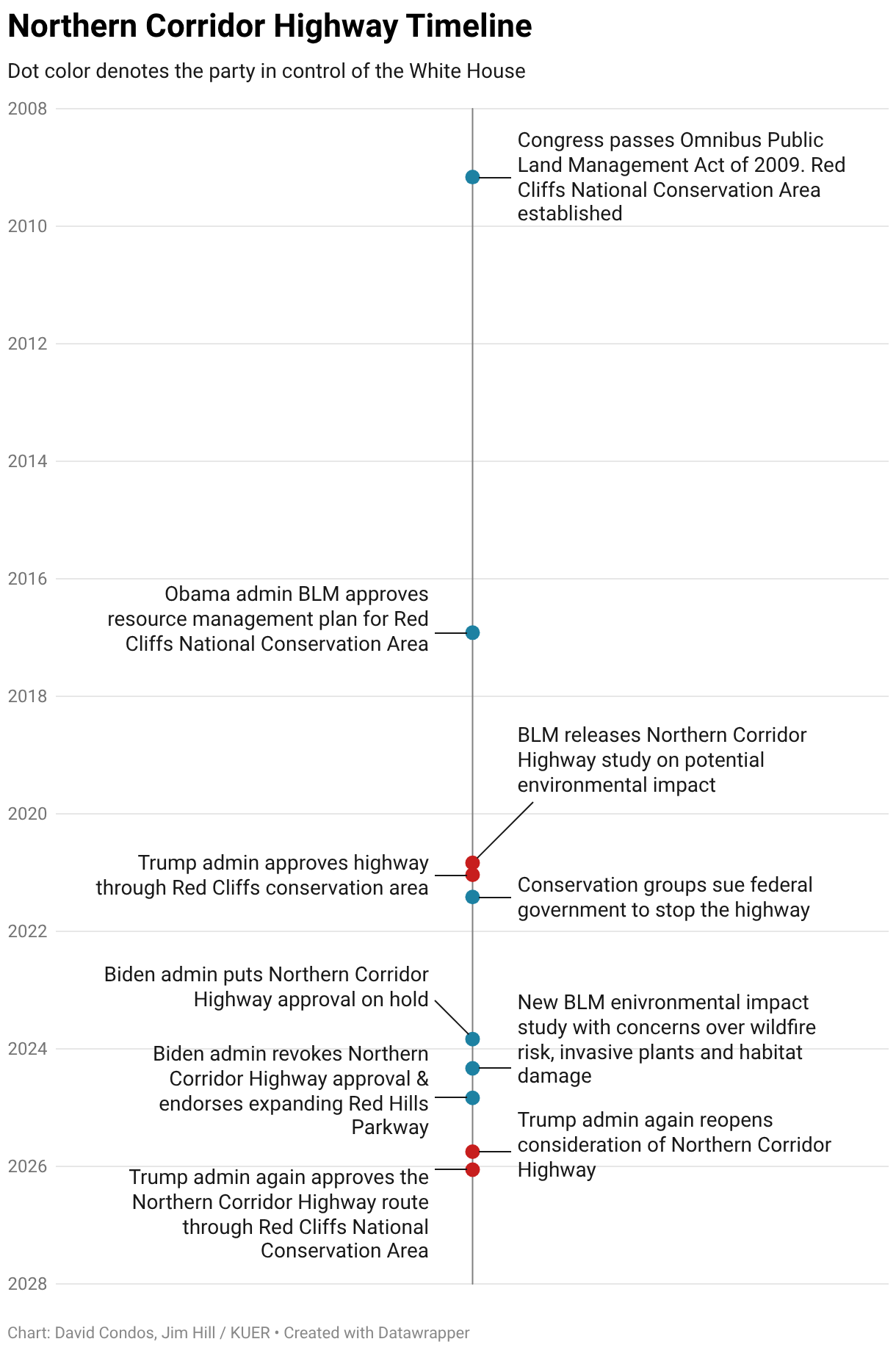
It’s the latest chapter in a long, contentious saga between a highway labeled as vital for future growth and the habitat home to threatened Mojave Desert tortoises.
The debate hinges on just a few sentences written in a federal act nearly two decades old. The language established the conservation area and its purpose to protect the landscape. It also asked the Bureau of Land Management — the agency that operates Red Cliffs — to pick a potential transportation route through its land north of St. George.
Both sides argue the legislation backs their position.
To get a broader perspective, KUER asked four public lands legal experts from across the country to weigh in. By and large, they question whether the highway’s approval fits with what the Omnibus Public Land Management Act of 2009 says.
“It would be unreasonable to assume that that includes building a road directly through these areas,” said Alejandro Camacho, a public lands law professor at the UCLA School of Law. “Now I realize that for decades, people have been talking about it as such. That doesn't mean that that's a good interpretation.”

The omnibus signed into law by President Barack Obama is hundreds of pages long and covers land across the West. Just two short parts of it relate to the Northern Corridor, numbered as sections 1974 and 1977.
The first sets up the national conservation area and lays out its purposes to conserve, protect and enhance a long list of resources. Some of those are ecological, scenic and recreational.
Chris Winter, a public lands attorney and executive director of the Getches-Wilkinson Center at the University of Colorado Law School, called that the “most permanent protection we have — congressional designation.”
“Permanent protections that limit very clearly and explicitly the types of uses that can be approved,” he said.
To Winter, that means the wording in the other section would need to clear a high bar in order to override the language that established Red Cliffs.
But the language of the bills’ second section on travel and transportation is a bit vague, said Sam Kalen, environmental law chair with the McKinney School of Law at Indiana University Bloomington. Prior to his current position, he founded and co-directed the Gina Guy Center for Law and Water at the University of Wyoming.
The first section that established Red Cliffs “is going to take precedence on anything related to the management of the conservation area,” Kalen said. The travel management section “has to be subservient, obviously, to the specifics of the management of the conservation area,” because the travel section language is less clear.
That would especially be true in a case like this, Winter said, where a highway may be in conflict with Red Cliffs’ stated purposes.
“I think it's a pretty big lift to say, ‘Oh, well, because of this travel management section, that means we can do whatever we want in the national conservation area or we can approve a new highway through there, even if it's going to set back the purposes for which that area was protected by Congress,’” he said.

The geographic scope of the travel management section is the entirety of Washington County, Winter said. So, it would allow the BLM to identify a potential transportation route on any of its land in the county, not just within Red Cliffs.
The section as a whole also focuses more on recreational trails than roads, said Karen Bradshaw, a professor who teaches property and natural resources law at the Sandra Day O’Connor College of Law at Arizona State University. So, a four-lane highway “seems outside of the scope of what's anticipated for this.”
And if the conservation section is more comprehensive, that one likely wins out.
“In a conflict between the two, it's hard to imagine how the trail provision, which is narrow and limited, would supersede the broader portion of the conservation management plan,” she said.
The second section calls for the BLM to “identify 1 or more alternatives for a northern transportation route in the County.” That’s the portion local leaders have pointed to as evidence that the Northern Corridor Highway is baked into Red Cliffs’ establishment.
Some of the experts, however, said the call to “identify” potential routes sets a minimum requirement for the BLM, rather than explicitly commanding the highway’s construction.
“That means you're really wanting them to just identify,” Kalen said. “Normally, when you have language like that, it's not directing. It still gives the agency discretion, and that's really important.”

Because the BLM has identified multiple route alternatives, including in its latest decision, it’s possible the agency has already fulfilled what the language asks for.
“It's a mandate to BLM to do the travel management plan and to identify the possible routes,” Winter said. “But that doesn't mean that the route has to be approved, if it's in conflict with the other section.”
That brings up one potential procedural hurdle. The 2009 act clearly mandates that the BLM create a travel management plan for Red Cliffs, which might help clear up uncertainties about what the transportation section intends. But it appears that no such plan has been written and approved.
“That is the real question,” Bradshaw said. Because it’s possible a court could say the BLM should complete that first required step before moving on to others.
“As I see it before me, the bill here requires a particular action. And if that action hasn't been taken, I don't understand how they can move forward with this plan” for approving the highway, Bradshaw said.
Despite the latest approval, the Northern Corridor could still likely end up in front of a federal court judge someday, Winter said, in order to get lasting resolution on the subject.

While conservationists have concerns that a judicial approval of the highway through Red Cliffs could set a national precedent that would put all national conservation areas at risk, Winter doesn’t go that far.
“We're talking about a very specific interplay between two sections of the Omnibus Public Lands Bill,” Winter said, “and that's not necessarily going to be in play in every national conservation area around the country.”
The Northern Corridor case is a fairly unique set of circumstances, he said, so it would be important to make sure it doesn’t erode protections in other areas.
It’s hard to predict how the case would play out if it goes to court, but Kalen would expect a judge to first look at whether the BLM’s decision is compliant with the omnibus section about Red Cliffs’ purposes.

It appears the agency is attempting to explain its most recent approval by saying the project would enhance recreational access and education, he said. The BLM decision notes that a new biking path would be built alongside the highway, along with interpretive displays at waypoints. The decision also argues the BLM had to reverse its 2024 endorsement of an alternate traffic route because it now believes expanding that existing road in St. George is unfeasible.
“I'm not sure if that's an adequate enough explanation,” Kalen said. “So, I'm a little bit skeptical about that explanation.”
Still, he said the courts have historically given the BLM a lot of leeway to choose how to manage its land.
“Judges give the agency a fair degree of discretion in making decisions about whether or not the use of particular lands achieves the objectives,” Kalen said. “They just have to do a really good job of explaining their decision about how they've exercised their discretion.”
Whichever way the Northern Corridor shakes out, the experts said they will be watching closely. Because a court decision on this long-debated southwest Utah issue could send ripple effects across the West.


